
Affordability.
Energy.
Opportunity.
Let’s work together to build a stronger foundation for the future. Alaska’s brightest days are ahead!

North to the future!
Imagine an Alaska where we provide a world-class education for our kids, family-supporting jobs are plentiful, and abundant, low-cost energy powers our homes and economy. Imagine still thriving communities that are clean and safe, housing that is affordable, and a place where entrepreneurs come to build their dream businesses.
Does this sound too good to be true? Because if it does, it doesn’t have to be!
Whether you’re an Alaskan that has lived here for generations or just recently arrived, you know Alaska is a special place. And while we face some significant challenges, we’re blessed to live in a place that is richly endowed with an abundance of resources that can unlock the door to a future that may seem more like a dream than a potential reality.
Our district deserves a representative in Juneau who will focus on the issues and policies that will help us achieve this future. My pledge is to work with you, the Alaskans of House District 9, to better our today and improve our tomorrow. Alaska’s brightest days are ahead- let’s work together to build the state we love!
I would be honored by your support and your votes!
About John
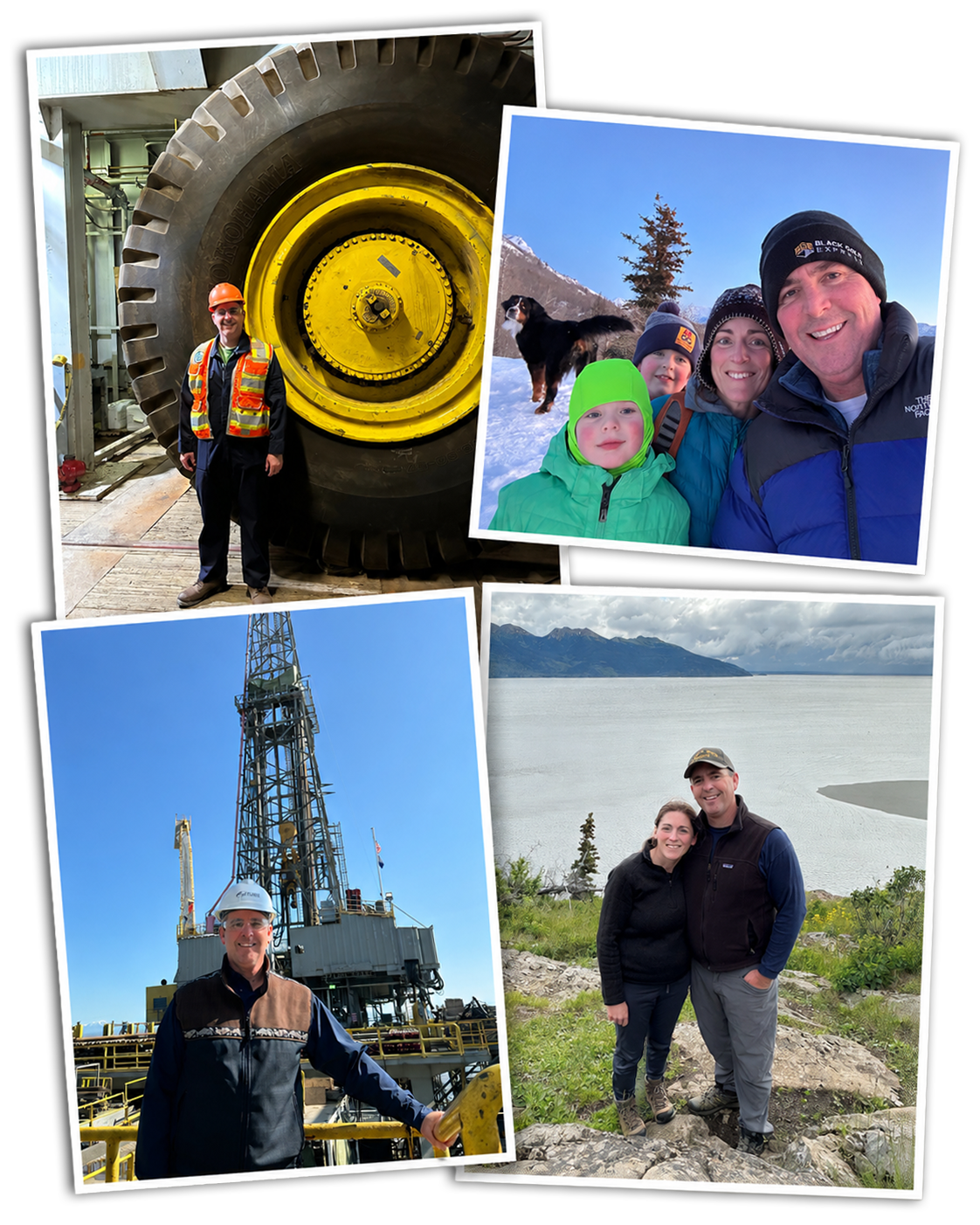
John came to Alaska fresh out of college, and the journey carried him all across the state. He struck out on his own as a law clerk to two judges in Fairbanks. From there, John found himself in Barrow (Utqiaġvik), working first as a borough attorney, then as chief of staff, for the North Slope Borough Mayor.
For nearly a decade, John worked in the oil and gas sector, holding management roles at BP, Oil Search, and Santos.


In 2022, John was asked to lead the Alaska Department of Natural Resources, the largest non-federal land management portfolio in America. For two years, John oversaw an agency responsible for oil and gas, mining, forestry, wildland firefighting and the country’s largest state park system.
Currently, John is Chief Strategy Officer for STAK energy, an Alaskan start-up working to develop a natural gas fired powerplant on the North Slope.


The most important part of John’s life is his family. John met Rosie, a fourth-generation Alaskan from Palmer. Happily married for nearly 15 years, John and Rosie raise their two kids on the Anchorage hillside.
John has spent most of his career working around the decisions that shape Alaska’s economy — in local government, the natural resources industry, and state government. He is now ready to share his time, talents, and efforts to make Alaska more possible for his kids and the next generation.
John On The Issues
Education
Being married to a teacher, I’ve had a front row seat to our education shortfalls. Alaska can financially support good public schools and still ask the important questions about where the money is going.
The priority should be the classroom. We should ensure teachers are compensated fairly and are incentivized to stay, students of all abilities are given the support they need, and that class sizes are kept within reason.
Instead of writing a blank check to school districts, the Legislature should take a serious look at district administrative overhead and whether enough funding is actually getting into the classroom.
Juneau shouldn’t leave teachers, students, and their families hanging. Budgets should be stable and passed on time. And Schools shouldn’t be stuck pink-slipping our young teachers.
We can also support parents who choose other educational options for their children. A one-size-fits-all approach is not the best solution to prepare our kids for success.
Energy
Southcentral Alaska is staring down another winter without a sure idea where the energy will come from, or what it will cost.
That doesn’t make sense. We are an energy state, with all the options available to solve our energy problems. Name it, we have it: hydro, geothermal, biomass, tidal, natural gas, coal, nuclear, solar, and wind. The toolbox is overflowing.
We need reliable, affordable energy for our homes and businesses, schools and hospitals. Our military depends on energy to keep our bases operating. In the middle of January, that switch for the heater, and the lights, needs to turn on without interruption.
Without this key ingredient in our community, the economy falters. Every family suffers when their savings burn up in the ductwork. Businesses suffer as their operating costs increase. And the more money government spends on energy, the fewer services it can provide.
Our legislature has had years to take action to encourage more energy development but chose to do nothing. Rather than take action to help enable a gas line from the North Slope, they decided to push for a tax on the energy companies producing nearly all of our gas in Cook Inlet. They have no alternative to offer.
These failures mean one big thing: our state, awash in energy, will have to import gas to heat our towns. Imported LNG will likely be twice as expensive as Cook Inlet gas. That all flows to the monthly heating bill, and it’s going to devastate Alaskans.
We can, and should, do better. First, do no harm in the Cook Inlet. We need all the gas we can possibly get to delay expensive imports as long as possible.
Second, we need a predictable environment for energy projects to get developed.
Lastly, we need to be open to Alaskan-based energy solutions. That means realizing we aren’t on a lower-48 grid, and need to build resilience and backup energy sources that make sense.
Wildfire
Wildfire is a real concern on the Anchorage Hillside and along Turnagain Arm.
There are neighborhoods with heavy vegetation, steep roads, and limited ways out. Once a fire starts moving, those conditions matter.
The work has to happen before fire season gets bad.
That means reducing fuels, maintaining access, managing vegetation around utilities, properly resourcing state and local fire agencies, and making sure people know how they are supposed to evacuate.
Nobody can control the weather. We can control how we are prepared for it.
Housing
Alaska needs more housing. But saying that over and over does not make homes appear.
Part of the problem is that building has become too slow, too complicated, and too expensive. Every additional delay, permit, review, and unnecessary regulatory requirement eventually shows up in the price of a home.
The state should work with local governments to streamline regulation, speed up permitting, and make straightforward residential projects easier to move from an idea to construction. Regulations should solve an identifiable problem. When they do not, they should not remain in place simply because that is how the system has always worked.
If Alaska wants more housing, government has to become better at allowing people to build it.
The state can also look to free up its available land to increase areas available for development. It can also invest in infrastructure such as roads, bridges, and tunnels to provide more access and expand housing opportunities.
Fiscal Policy
Alaska has some difficult budget decisions ahead.
The state still has to pay for schools, roads, public safety, infrastructure, and basic services. Pretending those obligations do not exist is not a fiscal plan.
First, we should take the Permanent Fund and the PFD out of the hands of politicians. Allowing legislators to spend from the earnings reserve portion of the fund and set an ad-hoc dividend each year is not prudent. The value of the Permanent Fund should be preserved and a sustainable formula for the PFD should be enshrined within the AK Constitution
Our next approach should be to look first at growth, spending priorities, administrative costs, and whether existing programs are actually working before reaching for new taxes.
That means being willing to ask what government should stop doing, what it can do more efficiently, and where private investment can grow the economy and the tax base.
It also means being careful about making new long-term promises for which future legislatures and taxpayers will be responsible. We must focus on affordability for all Alaskans.
Opportunity
I grew up in a small business family. My dad made it clear what it took to put food on the table for us kids, and for the people who worked with him.
Starting a business is already risky enough without government becoming another unpredictable part of the equation. Unfortunately, our legislature does not seem interested in focusing on how Alaska can compete to attract more entrepreneurs to our state.
Permitting and regulation should be clear. Businesses should know what is required, how long a decision should take, and who is responsible for making it.
That does not mean getting rid of standards. It means making the system understandable and making decisions on time.
Alaska also needs the basics that businesses depend on: reliable energy, enough housing for workers, functioning roads and infrastructure, and a tax and regulatory environment that people can plan around.
A healthy private economy creates jobs, supports families, and gives more young Alaskans a reason to stay.
Resource Development
Alaska has a natural resources portfolio that is the envy of the world. We have abundant energy potential, rare earths and critical minerals, productive forests for timber, arable land for agriculture, and a landscape that draws millions of visitors to the state each year.
This should give us all cause for optimism over the state’s future.
So why isn’t our economy already booming? Policy. Resources don’t develop themselves. They take capital, permitting, infrastructure, and people or companies willing to take risk. Often, these types of projects can take years if not decades to come into fruition.
And because most of our resources are located on state or federal lands, they are susceptible to decisions made in Juneau or Washington, D.C.
The State of Alaska can do its part by keeping taxes fair and consistent, surveying and identifying exploration opportunities, ensuring permitting agencies are properly staffed and issuing permits timely, and investing in infrastructure needed to facilitate development.
Alaska’s resources can continue to provide a strong foundation for our private sector. But we must ensure that we don’t allow short-term thinking to derail opportunities that will create family-supporting jobs, grow the Permanent Fund and provide revenue for decades to come.
Affordability
Alaskans all across the state are grappling with the cost of living. Our energy is costly, a basket of groceries at Fred Meyer costs an arm and a leg, and filling up at the pump is a painful exercise.
In Anchorage, the municipality continues to drive up the assessed values of our homes and our property tax bills. And housing costs are keeping home ownership out of reach for too many of us.
Now is not the time to impose new income taxes on the backs of working Alaskans. It’s already expensive to live here and the state should be looking for ways to lower costs- not increase them.


Want to Get Involved?
I would be honored to have you be part of my campaign. Please fill out the form below so we can get in touch with you.